Heather and Melinda First Become Acquainted in Art Class
Editor's annotation: The New United kingdom of great britain and northern ireland Museum of American Art provided source material to Resource Library for the following article. If y'all have questions or comments regarding the source cloth, delight contact the New Uk Museum of American Fine art directly through either this phone number or spider web address:
- 860-229-0257
- http://www.nbmaa.org/
Aloha: Hawaiian Fine art and Artifacts from the Sullivan Drove
November 30, 2013 - March ii, 2014
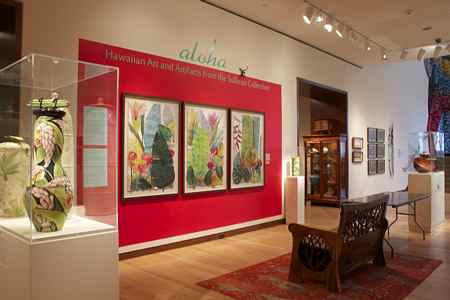
(above: Gallery View for Aloha: Hawaiian Art and Artifacts from the Sullivan Collection. Photo courtesy of New Uk Museum of American Fine art)
T raveling nigh 5,000 miles from Hawaii to the New United kingdom Museum of American Art, Aloha: Hawaiian Fine art and Artifacts from the Sullivan Collection, on 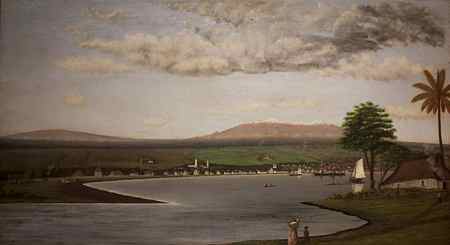 display at the New Britain Museum of American Art November thirty, 2013 through March 2, 2014, presents a cantankerous section of the civilization, beauty, and history of the Islands of Aloha. Despite the geographical distance between Connecticut and Hawaii, the two states' histories intertwined start in the 1820s, when many Connecticut missionary families such as the Lymans, Coans, Cookes, Wilcoxes, and Baldwins came to the Islands. (right: Joseph Nawahi, View of Hilo Bay, Hawaii, ca 1868-70, Oil on canvas, xx ten 36 inches. Collection of Melinda and Paul Sullivan.)
Longtime Museum benefactors Melinda and Paul Sullivan have carefully collected works from a wide range of artists, mediums, and contexts over the years. Selections from their extensive holdings of historical and contemporary works include paintings, works on newspaper, piece of furniture, and crafts spanning over two centuries of Hawaii'southward vibrant history.
Eighteenth-century engravings by John Webber (1751-1793) depict the islands as they appeared when English language explorer Captain James Cook reached Hawaii in 1778. Other pieces also capture the Western impression of the Islands, merely most celebrate the state's natural beauty through the eyes of native artists.
Ane of the highlights of the Collection is a nineteenth-century oil painting by artist, political leader, scholar and activist Joseph Nawahi (1842-1896). Although he received no formal art grooming, Nawahi became the first Hawaiian-born artist to paint in a naturalistic "Western" style.
Other treasures such equally quilts made in the traditional Hawaiian fashion, furniture crafted of native Koa wood and shell necklaces from the remote island of Niihau will also be on brandish. Visitors will have the opportunity to travel through more than 200 years of history, as well as get acquainted with artists living and working in the Aloha State today.
Selections from the Sullivan Collection offer a rare glimpse into the art and history of the Islands of Aloha
Collectors' Statement
Our appreciation for Hawaii and its rich culture grew over the nine years that we lived on the beautiful island of Maui. We have studied Hawaiian history and the diverse artists that have interpreted aspects of Hawaiian civilisation in a broad multifariousness of ways. It is a pleasure for the states to share with the visitors to the New Great britain Museum of American Art the paintings, prints, furniture and decorative arts objects on view.
We have caused more than 200 Hawaiian ornaments, and these will be hung from our tree in the lobby over the holidays.
Nosotros became intrigued by the origin of the Hawaiian people who settled the Hawaiian Islands over one,500 years ago. They migrated from Samoa and Tahiti. Much later, with the arrival of the starting time Europeans in the 18th century, a gradual blending of cultures began which continues to this mean solar day. In particular, in the 19th century American Christian missionaries, many from Connecticut and elsewhere in New England, began to exert an enormous influence on the destiny of the Hawaiian Islands. Additionally, waves of Chinese and Japanese workers were brought to the Islands to work in the sugar cane industry and in the pineapple fields. The result was a rich blending of world cultures that has produced wonderful fine and decorative arts objects based on the folklore and mythology of all of these peoples.
Nosotros wanted this collection to stand for the varied communities that came to Hawaii over time. Considering our primary interest was decorative arts and paintings, we assembled artworks representative of the Islands, including seascapes and "up country" landscapes by contemporary artists. Well-nigh of these individuals are non native Hawaiians, but and then again, everyone on the Hawaiian Islands came from somewhere else at once or another. While contemporary, the furniture and artifacts were fabricated in the style of before periods.
Margaret Leach's storyboards give a rendering of how the early settlers (Samoan and Tahitian) explained the origin of their state. The Webber prints and others reveal the period of European discovery in the last quarter of the 18th century past explorers such as Captain James Cook and the Comte de Lapérouse.
The 19th-century painting by Joseph Nawahi is the work of a native Hawaiian, educated by New England missionaries. Information technology is one of only twelve known works by this artist, who was likewise active in the Hawaiian law, politics and social issues during the 2d half of the 19th century. We likewise have included an example past the "Volcano School" creative person, D. Howard Hitchcock, who was born in Hilo in 1861, the grandson of missionaries from Massachusetts.
The rise of tourism has played a major role in the lives and economy of the Hawaiians starting time in the 20th century. The six menus on brandish were presented to outset course passengers aboard the luxury liner S.Due south. Lurline of the Matson Line. Carrying passengers from the Westward Declension to Honolulu, the line operated from 1933 to 1963 when the jet plane made it obsolete.
To usa Hawaii is a magical place and we promise this exhibition imparts some of the wonder that has inspired us to class this collection.
- Melinda and Paul Sullivan
Wall panels from the exhibition
- SANFORD BALLARD DOLE LOW: NEW BRITAIN AND HAWAII
- Sanford B.D. Low (1905-1964), New U.k. Museum of American Art's charismatic first manager, was born in Hawaii. His ancestors included Hawaiian royalty and Connecticut missionaries. Sent to Connecticut's Loomis Chaffee School from Hawaii, he evidenced artistic talent at a young historic period. He pursued his educational activity at the Fine art Students League, where he met Virginia Hart, his future married woman, who was as well a painter/illustrator. Ginny Low was the granddaughter of William H. Hart, who built the Landers House and was the CEO of the Stanley Works for more than than 50 years.
- In 1937 Low was asked to serve every bit curator by the New U.k. Institute, the parent organisation of the New Britain Museum. In the 1940s he was appointed the Museum'southward get-go director. Between then and his untimely death in 1964, he organized hundreds of exhibitions and programs. He also bought astutely and then that many of the Museum'due south virtually significant works of art, including Thomas Hart Benton's murals, The Arts of Life in America, were purchased past him.
- Low was a bon vivant. He sang, played the ukulele and was the life of the political party at many social gatherings. He continued to pursue his career every bit an artist and both taught and mentored hundreds of aspiring younger artists at the New Britain Art League, which he helped found. Amidst his many devoted friends were the leading illustrators of his day. Upon his death, information technology was decided that the Depression Illustration Commission would perpetuate his legacy by acquiring the finest American illustrations in his name. Since his expiry, the Committee has met twice a year, and annually donations come to the Museum so that today the NBMAA is home to one of the almost comprehensive illustration collections in the country.
- On Sunday, January 19th at 2 p.thousand., Depression'south son, Sam Low is coming to the Museum to commemorate the 50th anniversary of his father's death. His plan, entitled Aloha in the Hardware Capital of the World: Sanford B. D. Depression the Museums' First Manager, will be a tribute both to his begetter and his family'southward Hawaiian heritage. In large office, Sandy Low was responsible for assembling one of the country'south leading collections of American art, and thus we owe him a tremendous debt of gratitude.
- Douglas Hyland,
- Director
-
- HAWAIIAN KOA Forest
- Many of the furniture and decorative fine art objects shown in the exhibition (the pie safe, benches, glass forepart case, jewelry boxes, and a number of the bowls and frames) are fabricated from Hawaiian koa, a tree that is native just to Hawaii. Because of its durability, attractive and varying grains, and broad range of colors, koa offers the craftsperson a strong and beautiful medium with which to piece of work.
- While koa is now the preferred wood for Hawaiian-made objects, this was non always the example. Prior to the 1870s, kou woods was widely used. It had like qualities to koa but was softer and thus easier to cleave with early on stone and coral tools. Overuse and an imported insect pest led to the nearly extinction of the kou tree by the late 19th century, a cautionary tale for united states of america all.
- THE TARO Plant
- Colocasia esculenta
- Brought to Hawaii past the offset Polynesian settlers, the root of the taro plant is used to make "poi." In improver to being a nutrient staple, poi holds important symbolic value in Hawaiian culture. The taro plant itself is understood as "the older blood brother" of man; every bit "siblings" originating from the same source, they are responsible for taking intendance of each other. Thus, eating poi represents more unproblematic sustenance. It celebrates Hawaiian heritage and supports the ties of "o'hana" (family). Thus, the taro plant is a frequent motif in Hawaiian art such as the ceramic leaves and paintings shown here.
- JOHN WEBBER AND CAPTAIN Melt
- English language artist John Webber accompanied Captain James Melt on his third voyage in search of the Northwest Passage from Europe to Asia. Information technology was during this expedition that Cook fabricated the first documented European contact with Hawaii and its people in 1778.
- A predecessor of documentary photographers and filmmakers, Webber sought to accurately capture the organized religion, clothes, habits, architecture and people that Cook and his visitor encountered. Copperplate engravings of his drawings were made for the 1784 offset English language edition of A Voyage to the Pacific Body of water and other subsequent editions in numerous languages.
- Webber's works culminate in his delineation of the decease of Captain Cook in February of 1779 at Kealakekua Bay on the Large Island of Hawaii. As dramatic as was Cook's demise, the long-term bear on of Western contact was even more tragic. The native Hawaiian population declined from an estimated 300,000 in 1778 to just 45,000 by 1879 due to diseases to which they had picayune immunity.
- LEGENDS AND MYTHS
- Having no written language, the ethnic people of the Hawaiian Islands passed their history and life lessons down from generation to generation in the form of oral legends and myths. Considering they sought to live one with nature, many of the symbolic representations used in these stories are related to the natural world.
- The storytellers of these legends were accorded a position of honor. Their craft served as a primary source of amusement while simultaneously didactics how the ancestors lived in their world and how time to come generations should live in theirs. Although the ancient Hawaiian culture is very different from our own, within this folklore nosotros discover themes and emotions familiar to us in our mod world.
- Look to the left to discover three Hawaiian myths equally depicted past artist Margaret Leach.
Object labels from the exhibition
- MARGARET BEDELL (1922-2013)
- Conga II, Variation on a Theme, 2005
- Mixed media
- The trees and flowers of Hawaii have been a leading source of inspiration for artists since people began to settle on the Islands over one,500 years ago. Following the footsteps of famous painters like Georgia O'Keeffe (1887-1986), Margaret Bedell continues this tradition. Her triptych is a jungle of bold lines and shapes representing native plant leaves. We find the giant bird of paradise tree, taro and palm accentuated by flashes of bright color from caribaea, heliconia and anthurium flowers.
- SUSAN BOARDMAN (b.1956)
- Embroidered Narratives , 2001-2002
- Bone, leather, hand-dyed cotton fiber fabric, cotton thread, beadwork, koa wood frame
- In the 1800s, whaling was a major industry and played an important role in the history of Hawaii. Whale oil was a source of fuel and lubricant for the lamps and machines driving the industrialization of the Western world. Whaling began in the North Atlantic Ocean, but when whale populations began to drastically decline due to overhunting, whalers sought their prey elsewhere. The Pacific Ocean and Southward Atlantic Bounding main were ideal for whaling, and ships began arriving at the ports of Honolulu and Lahaina around 1819. By 1846, over 600 ships from all over the world docked there annually.
- Susan Boardman's embroidered narratives tell stories of 19th-century Nantucket women who accompanied their husbands aboard whaling ships. Notice the quotes from their journals along the sides of the embroideries. Although the six embroideries primarily depict voyages to the southernmost Atlantic and Pacific Oceans, they capture themes that were mutual throughout the global whaling merchandise.
- SUSAN BOARDMAN (b. 1956)
- Send Essex as She Appeared at the Moment of Assail on November 20 , 1820, 2001
- Os, leather, hand-dyed cotton fabric, cotton thread, beadwork, koa wood frame
- The sinking of the ship Essex was one of the most prominent maritime tragedies of the early on 1800s. A relatively small vessel, Essex was attacked by a large sperm whale ii,000 miles off the coast of South America. The ship capsized, and the crew retreated to smaller boats. Of the xx men, only 8 survived the treacherous journey dwelling. Essex's demise would later become the inspiration for Herman Melville'southward Moby Dick.
- CARRIE LEE BRADY (b. 1960)
- Gyotaku Fish Impress, 21st century
- Acrylic and colored pencil on rice paper
- Fish rubbing (Gyotaku) is an art grade that originated in Japan in the 1800s to tape a fisherman's catch before it was taken to market. The non-gutted fish is inked with water-based paints, and so a flexible paper or textile is pressed over the fish to capture the intricacies of its scales. Details like eyes and fins are added with colored pencil to closely represent the natural colors of the fish. In this impress, the reflection in the fish's optics takes on a near man quality and becomes the focal point of the work. Why might the artist have done that?
- Carrie Lee Brady started her formal art education when she moved to Maui in 1980. She lives a very active outdoor lifestyle which inspires the textures and colors in her works.
- GIOVANNI MARIA CASSINI (1745-1824)
- Le Isole Di Sandwich, 1990 (based on 1798 original)
- Limited edition, hand-colored copperplate etching
- This map was originally published (uncolored) in Rome in 1798 for Giovanni Cassini'due south three volume atlas. In 1990, it was reproduced equally a limited edition print. The Hawaiian Islands were originally named the Sandwich Islands past Helm Cook in laurels of his patron, John Montagu, 4th Earl of Sandwich. Detect that the names of the individual islands reverberate the 18th-century phonetic spelling of native Hawaiian pronunciations. Their mod equivalents are:
- Owhyhee - Hawaii (The Big Isle)
- Mowee - Maui
- Tahoorowa - Kahoolawe
- Ranai - Lanai
- Morotoi - Molokai
- Woahoo - Oahu
- Atooi - Kauai
- Oneehow - Niihau
- Note another version of the Death of Captain Cook in the bottom left of the map. Compare this to other iterations in the exhibition. How does it differ from the original by John Webber?
- CHRIS CHRISTENSON
- Palm Tree Surfboard, 21st century
- Fiberglass, polystyrene core
- Collection of Heather Vance
- Look in the Davis Gallery to notice A View of Karakakooa (Kealakekua), in Owyhee by John Webber, the beginning known Western depiction of surfing. Originally symbols of social condition, surfboards synthetic of koa wood ranged from 9 to 18 feet in length. At the height of surf civilisation in the 1950s and 1960s, surfboards evolved to be more than lightweight and maneuverable. In the 1970s, surf culture was often negatively associated with illicit substances and the display of prominent sexuality. However, this correlation did not last for long and global surf culture continues to proliferate today.
- MICHAEL CLEMENTS (b.1950)
- Kula Cabbage Field Workers (Harvest), ca. 2010
- Pastel on paper
- Michael Clements uses primarily pastels to capture both the pristine natural landscape and agricultural activities of his home isle Maui. Here, Clements finds beauty in the calorie-free and colors of a cabbage harvest in the Kula district. Located along the western gradient of the volcano Haleakala, the expanse is known for its rich soil and has supported agriculture for decades. Today, Kula is home to numerous botanic gardens and produce farms.
- Kula Cabbage Field Workers (Harvest) is one of the artist's largest, most ambitious figurative works. Long horizontal strips of cool greens, browns and blues create a calm background which is interrupted past the bold yellow jackets of the workers. Considering the championship, it is not surprising that Clements focuses united states of america on the workers more than so than the landscape through his use of contrasting color.
- D. P. DODD (Active 1768-1784)
- The Death of Captain James Cook, F.R.S. at Owhayhee in MDCCLXXIX, 1784
- Hand-colored copperplate engraving printed past Thomas Cook
- This image of the death of Cook was engraved from the original said to have been done not by John Webber merely by "D. P. Dodd and others who were on the spot." Unlike the Webber version, this scene shows Cook already dead or dying and being dragged from the beach. Note that information technology appears that some of the Hawaiians may be attempting to restrain others from violence. Clearly different artists chose to emphasize different aspects of Melt'south demise.
- RIK FITCH (b. 1947)
- "Wahine" (Lady on a Embankment), 21st century
- "Kane" (Man on a Beach), 21st century
- Oil on canvass
- In these two paintings, Rik Fitch illustrates his deep love for Maui's people, creature and flora. He considers himself a "modernistic impressionist artist." Would you concur?
- Symbolism has long been a common aspect of Hawaiian civilisation. Perchance the colorful fish above the reclining woman might correspond the Hawaiian Country Fish, Humuhumunukunukuapua'a, also symbolic of life, fertility, prosperity and riches. The turtle, or Hanu, may represent long life and the "living bridge that brings 2 lovers together."
- D. HOWARD HITCHCOCK (1861-1943)
- Hilo, 1921
- Oil on board
- Hitchcock, the grandson of missionaries, was the first Hawaiian-born painter to receive formal art grooming in Paris. He later became a leading member of the Volcano School. Though the painters in the Volcano Schoolhouse were best known for their dramatic, nocturnal scenes of Hawaii's erupting volcanoes, Hitchcock was every bit interested in Hawaii'due south lush and varied flora.
- This painting is a joyous depiction of Hitchcock's birthplace -- Hilo Bay. Here, the creative person uses a bright palette and loose, impressionistic brushstrokes to capture an idyllic glimpse of natural paradise, uncluttered by people or buildings.
- Compare Hitchcock's vision of Hilo Bay to Joseph Nawahi's View of Hilo Bay, Hawaii. Hitchcock focuses on a small department of beach, a pandamas tree and the ocean, while Nawahi gives us a much broader vista. How exercise the artists' choices about what to include in the composition affect your perception of what Hilo Bay was like?
- HEZEKIAH HUNTINGTON, N.Y. (Publisher)
- Eight Illustrations for A Residence of Twenty-I Years in the Sandwich Islands , 1848
- Mitt-colored woodblock engravings
- These eight prints appeared in Hiram Bingham's A Residence of Twenty-One Years in the Sandwich Islands. Bingham was one of the early missionaries to visit Hawaii and in the 21 years he stayed there, he contributed greatly to the success of the Lahainaluna High Schoolhouse (the first loftier school w of the Rockies). He helped interpret the Bible into Hawaiian (a previously unwritten language) and develop Hawaii's first printing printing.
- MICHAEL JAMES
- Mataatua, ca. 2010
- Pencil on newspaper
- Michael James taught herself to draw during her recovery from several surgeries. Drawing has proved to exist an adventure which has freed her to "express what I feel in my heart."
- Mataatua is a hula trip the light fantastic "specific to the Makena area of Maui. It represents a road from hardships on the fashion to a Promised State in life." The effigy here, Kolani Au, is a dancer specializing in "Ulanena," which references a air current-driven reddish-hued rain experienced in some regions on the island of Maui.
- AVI KIRIATY (b. 1957)
- Papa Tonga, 2010
- Oil on canvas
- Born in Israel but now a resident of Maui, Avi Kiriaty has immersed himself in the life and culture of Polynesia. He painted Papa Tonga in a assuming style reminiscent of the cubist piece of work of Pablo Picasso (1881-1973) combined with the color and subject matter of Paul Gauguin (1848-1903). The field of study, a fisherman resting with his take hold of, is representative of Kiriaty'southward depictions of ordinary people engaged in their everyday piece of work and activities. Other Kiriaty examples, such as Shell Fisherman and Feeding the Chickens, also demonstrate his focus on what his daughter has called a "nostalgic search for a simple, loving lifestyle working with the state and ocean."
- Did you notice the two night bands reaching down from the cloud just behind the fisherman's head? These are intense sheets of pelting typical of the Southward Pacific chosen a "Nighttime Summer Squall."
- HEESOO LEE AND ADAM FIELD
- Old residents of Hawaii, this husband/married woman team now shares their studio in Durango, Colorado. Both are trained in traditional Korean pottery making techniques. Adam Field's Celadon Vase (eye) is reminiscent of the simplicity of antique Far Eastern pottery. The etching on his work is informed by the patterns constitute in ethnic fiber art, such as the Hawaiian tapa cloth. Heesoo Lee's vessels illustrate plants unremarkably found in Hawaii. Plumeria flowers (as seen in the vase on the left) are a garden favorite. Considering they are sugariness-smelling and like shooting fish in a barrel to string, they are too used widely in the lei trade. Shell Ginger (every bit seen in the vase on the right) is normally found in moisture areas and is one of nine species of effluvious ginger used in the lei. It is also grown for medicinal purposes, spices, dyes and perfumes.
- BETH MARCIL (b.1958)
- Lo'i Kapahulu (Wetland Taro Field of Kapahulu)
- Acrylic on canvas
- Beth Marcil was born in Southward Carolina and graduated from Ringling College of Fine art and Design with a degree in analogy. In 1984 she visited Maui and never returned to the mainland. She refers to herself as a "creative midwife" because of the prevalence of vivid colors, textures and energies in her piece of work. This painting of a taro field is no exception.
- The taro plant was the mainstay of the Hawaiian nutrition and considered to be most important to their survival and prosperity.
-
- NANCY SHEPARD MOSELY (b. 1947)
- Mu'u Mu'u (Muumuu) Miniatures , 21st century
- Polymer dirt
- During the "golden age" of the Aloha shirt in the 50s, celebrities like Elvis Presley and Bing Crosby popularized the garment, increasing the need for traditional and innovative designs. This gave style to the adaptation of the Aloha shirt patterns in other articles of wear, such as bathrobes, bathing suits and the long Hawaiian dress chosen the mu'u mu'u (muumuu), which y'all see recreated here as a miniature.
- PETER NARAMORE (b. 1954)
- Pie Prophylactic, 21st century
- Walnut with copper panels
- Prior to refrigeration, the pie safe provided cooks a place to absurd and store pies (and other foods), abroad from flies and vermin. Find the holes in the copper door panels for ventilation. The pie prophylactic was introduced to Hawaii past American missionaries and settlers, many of whom came from New England.
- This pie safety is made in a tardily 19th-century Craftsman style simply has copper door panels instead of the traditional tin. The copper sheets are punched in stylized patterns like to Hawaiian quilt designs, a nod to the flora of the Islands. The peak panel is similar to the "Kukui Grove of Lanikaula" pattern; the middle is similar to the "Maile Lei" pattern; and the bottom resembles the "Awapuhi" (Hawaiian Red Ginger) pattern.
- Peter Naramore is a furniture designer and craftsman working on the island of Maui.
- JOSEPH NAWAHI (1842-1896)
- View of Hilo Bay, Hawaii, ca. 1868-1870
- Oil on canvass
- Are we looking at a small New England town in the mid-19th centrury or Hilo Bay, Hawaii? Hawaiian- born artist Joseph Nawahi, also a noted politico, scholar and activist, was the first native Hawaiian to paint in a distinctive Western fashion. Notice the clothing, the flags, the buildings, the ships and the open up dark-green fields. Even the water seems gray and smooth like a river or bay in New England.
- By the 1860s, missionaries, many from Connecticut, had settled in the Islands and created settlements with white clapboard churches and buildings that resembled their previous homes in New England. Simply the palm trees, the afar volcanoes, the small outrigger canoes in the bay and the Hawaiian flag give Hilo away. When Nawahi painted View of Hilo Bay, Hawaii was an independent kingdom; its flag was a combination consisting of an American flag and with a British Union Jack in the upper left corner.
- JOËLLE C. PERZ (b. 1951)
- Traditions and New Visions , 2013
- Mixed media on carved wood
- here are numerous myths and legends that explain the creation of the hula, a complex and graceful ritual trip the light fantastic form accompanied past music or chant, but essentially it is used as tribute to the sister goddesses Laka (goddess of the forest and hula) and Pele (goddess of volcanoes). Today, it is too considered a celebration of the Aloha spirit (traits of character that express the amuse, warmth and sincerity of Hawaii'southward people.)
- Joëlle C. Perz'south Traditions and New Visions depicts the 5 sacred plans associated with the hula.
- EUGENE Brutal (1883-1978)
- Dinner Menus from the Due south. S. Lurline, 1954-1956
- Offset prints
- In 1938, Matson Lines commissioned Eugene Savage to create six murals depicting Hawaiian life. On display are the adaptations of those murals into menu covers for the cruise ship S. Due south. Lurline. In 1908, seafarer William Matson built a ship named Lurline which would get the first commercial passenger ship in the Hawaiian trade. The subsequent S. Due south. Lurline, a luxury cruise ship, began shuttling passengers from California to Hawaii in 1932, helping popularize Hawaii as a favorite travel destination.
- Unknown Creative person
- View of the French Frigates Anchorage off of the Island of Maui, 1797
- Copperplate engraving published in Atlas Du Voyage De Lapérouse
- England was not the just participant in the exploration of the Pacific. The Comte de Lapérouse, noted French explorer, navigator and hydrographer, was sent by King Louis Sixteen on an expedition in rivalry with Captain Cook and the English. Lapérouse was the first official company to Maui ("Mowee" on this print). The view shown here was recorded in 1786, a few years before the volcano in the groundwork, Haleakala, erupted and wiped out the village shown in the epitome. The lava fingers of the volcano created what is known today as La Perouse Bay.
- DAN WARREN
- Village Life, 1993
- Line etching on zinc plate printed on burnt umber ink, hand colored
- Arriving every bit early as one,500 years ago, the primeval settlers of the Hawaiian Islands are believed to have been Polynesians from the Marquesas Islands. They arrived in double-hulled canoes bringing with them coconut and banana trees, dogs, pigs, and chickens. They governed themselves by a kapu system of chiefs and ali'I (royalty). Their organized religion was deeply associated with nature and recognized thousands of gods. By the time Europeans made contact in 1778, there may accept been as many as one million inhabitants.
- Considering this information, tin you find evidence in this etching to support the possibility that it depicts an early settlement?
- JOHN WEBBER (1751-1793)
- A Homo of the Sandwich Islands with His Helmet , 1790
- A Young Adult female of the Sandwich Islands, 1790
- Hand-colored copper plate engraving printed by Alex Hogg
- The portrait on the left is believed to be main Keneena. He is dressed in a feathered cloak and helmet ("mahiole"), likely for a formalism occasion. Cook's notes indicate "Keneena....was 1 of the finest men I e'er saw. He was well-nigh six feet loftier, had regular and expressive features, with lively dark eyes; his carriage was easy, firm, and svelte." Unfortunately, Keneena was killed in the same battle as Cook shortly subsequently Webber made his portrait.
- The adult female on the correct may be Poeta, daughter of an isle chief. Rare and cute bird feathers were reserved for high ranking individuals, and then based on the plume head lei, she too is clearly a person of importance. Melt's notes state "...besides which they habiliment another ornament called eraie (lei).....it is a ruff of the thickness of a finger fabricated.....of exceedingly modest feathers, woven so shut together equally to form a surface every bit smooth as that of the thickest velvet."
- JOHN WEBBER (1751-1793)
- A Canoe of the Sandwich Islands, the Rowers Masked, 1784
- Copperplate engraving printed by C. Grignion
- This scene shows a grouping of men, believed to be priests of the god Lono, traveling in their two hulled canoe. Ane of the priests holds a feathered representation of the god Lono chosen an Akua Hulu Manu, while the man behind him blows on a conch shell trumpet. All of the men wear masks that are associated with ceremonies honoring Lono. Melt's notes of the voyage indicate that "the masks were made of large gourds with holes cutting out for eyes and nose. The top was stuck total of modest dark-green twigs, which at a altitude, had the appearance of an elegant waving plum; and from the lower part hung strips of fabric resembling a beard..."
- JOHN WEBBER (1751-1793)
- The Death of Captain Cook, 1784
- Copperplate engraving printed past William Byrne and Francesco Bartolozzi
- Helm Cook's relations with the native population were initially friendly but deteriorated quickly due to cultural misunderstandings. To reclaim a stolen boat, Melt's crew attempted to have hostage the King of Hawaii, Kalani`pu`u. The natives retaliated by attacking and killing Cook and four marines. Nineteen Hawaiians died in the atmospherics and many more in subsequent reprisals.
- Webber was not present at the actual boxing and based his delineation of Cook's death on eyewitness accounts. Hither, Cook tries to human action as a peacemaker moments before he is struck from behind. Note how other versions of this consequence show Cook in the thick of the fighting or already dead.
- JOHN WEBBER (1751-1793)
- Mort de Melt, 1785 (hand-colored at later date)
- Copperplate engraving for first French edition of A Voyage to the Pacific Ocean
- This version was done for the French edition of A Voyage to the Pacific Body of water and is very similar to the original work engraved past Bartolozzi and Byrne from the watercolor past John Webber. The hand coloring was done at a later appointment and reflects the creative person'due south best guess regarding the colors that the participants really wore.
- CHARLES WILKES (Publisher)(1798-1877)
- Crater of Maku-A-Weo-Weo , 1856
- Hand-colored engraving
- Lieutenant Charles Wilkes led the first U.Southward. trek to survey the South Pacific, including Hawaii. One of the major accomplishments of the expedition was the mapping of Hawaiian volcanos, such as Mauna Loa, which you run across here. The crater in this image is located on the top of the mountain.
-
Leiomano (Shark Toothed Club) , 21st century
- Wood, shark teeth
- Meant for short-range fighting, this paddle-shaped club has sharks teeth inset into grooves on the edge of the club and sewn in place. There is a hole in the handle to hold a wrist wrap to prevent the user from losing it during boxing.
- Such clubs have been used for centuries within many Polynesian cultures for utilitarian and martial arts purposes. In Hawaiian, the word "leiomano" may be derived from "lei o mano," pregnant "a shark's lei."
-
Monstera Leafage Appliqué Quilt, 21st century - Machine and manus-stitched cotton
- This 21st century recreation of a traditional Hawaiian quilt represents the merging of two cultures. Prior to contact with the W, native Hawaiians wore simple garments made from "kappa" fibers which featured hand-painted decorations of local plants. In the late 18th and early on 19th centuries, travelers from the U.S. brought with them the tradition of the patchwork quilt. Native Hawaiians before long started creating primarily appliqué quilts which included representations of local foliage such equally the Monstera foliage, as seen here.
- Pohaku Ku'I Poi (Poi Pounder) , 21st century
- Lava rock
- The poi pounder is considered one of the about valuable Hawaiian stone implements. After steaming or baking the taro root, in one case considered the Hawaiian "breadstuff," the tool was used to beat out and knead the cooked root into a paste called "poi." After, poi would be mixed with h2o to produce a sweetness, highly nutritious mixture that could be eaten all by itself.
- Three Ni'ihau Shell Leis , ca. 2000
- Assorted shells
- The tradition of Ni'ihau shell leis, or pupu, comes from the small and remote island of Ni'ihau. Because of its arid climate, Ni'ihau contains fiddling vegetation, and the pupu has been adopted as the isle's "flower." For centuries, craftsmen have scoured the shores of Ni'ihau for tiny shells that accept done ashore. After sorting the shells by type, size and colour, they would advisedly pierce and string them into complex designs. Because this procedure is so painstaking, Ni'ihau leis have always been seen as precious, luxurious jewelry -- the Hawaiian equivalent of the pearl necklace.
- On brandish are 3 contemporary examples of Ni'ihau leis. The longer lei is a three-strand Lei Kui Pikake, pregnant "sewn similar a flower lei of jasmine." The smaller leis are an example of Lei Kui Kipona or "lei sewn with a mixture of shells." Today, the Ni'ihau Island is privately owned and near inaccessible to outsiders, making the leis made in that location all the more coveted.
- Wooden Bowls (Calabashes) , 21st century
- Hawaiians were known to brand some of the most beautiful bowls in all of Polynesia. Known as "calabashes," these bowls were made from coconuts, gourds, fiber, or woods. Historically, they are associated with serving poi, a nutrient fabricated from the taro plant which possesses of import nutritional and cultural significance to Hawaiians. Wooden bowls were highly coveted because they were hardest to hand-carve; thus, they were reserved for Hawaiians of high rank.
- Note the beautiful grain and color of the wood -- something the makers of these contemporary calabashes took great intendance to accentuate in the carving process.
- Maile (Top Left): This institute represents the legend of the five Maile Sisters, minor goddesses of hula, who could accept human being or plant forms. Wearing maile was believed to provide dancers with inspiration and improve their skill.
- Ie ie (Top Correct): Legend has information technology that Ie ie was the supernatural form of Lono, the hubby of Laka. It represents the decision and cognition possessed by the students of the hula.
- Ohi'a lehua (Center): This plant is placed on the hula altar and represents female and male elements, the forest being the male person and the blossom being the female.
- Palapalai (Bottom Left): This plant can be placed on the hula altar and worn as leis by the dancers. It evokes the sister of Pele, Hello'iakaikapolio Pele, benefactor of the dancers.
- Halapepe (Bottom Correct): This plant represents the symbolic form of Kapo'ulakina, the goddess of sorcery.
-
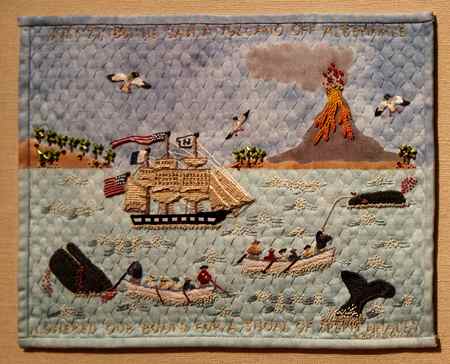
(above: Susan Boardman, Embroidered Narrative, 2001-02, Leather, hand-dyed cotton cloth, cotton thread, beadwork, koa wood frame, 14.5 x 11.5 inches. Collection of Melinda and Paul Sullivan)
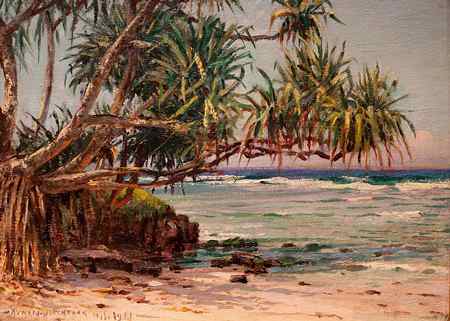
(higher up: Howard Hitchcock, Hilo, 1921, Oil on canvass, xi x 16 inches. Collection of Melinda and Paul Sullivan)
Additional images of artworks in the exhibition
To view additional images of artworks in the exhibition, please click here.
Resource Library readers may also relish:
- Hawaii Art History
See America's Distinguished Artists for more than biographical information on historic artists cited in the above commodity.
Read more articles and essays concerning this institutional source by visiting the sub-index folio for the New Britain Museum of American Art in Resource Library.
Search Resources Library for thousands of articles and essays on American art.
Copyright 2014 Traditional Fine Arts Organization, Inc. , an Arizona nonprofit corporation. All rights reserved.
Source: https://tfaoi.org/aa/10aa/10aa290.htm

Enregistrer un commentaire for "Heather and Melinda First Become Acquainted in Art Class"